This Activity relates to the second Key Idea within Literacy as Languages in Use:
- Fluency and innovation in listening to, reading, viewing and creating texts for different purposes and contexts (ACARA, 2019).
This can be related to the Year 9 English Content Descriptor:
ACELT1634:
Reflect on, discuss and explore notions of literary value and how and why such notions vary according to context (ACARA, 2019).
Students are required to develop fluency and innovation in listening to, reading, viewing and creating texts for different purposes and contexts. This can be done through reflecting on, discussing, and exploring notions of literary value within poetry and how and why such notions vary according to context.
Teacher’s Notes:
Many students often complain when studying poetry that they don’t understand what is being said, as the rhyming and language used can be confusing.
It is important that students overcome these hurdles and develop a fluency when listening to, reading, viewing and creating texts for different purposes and contexts. Discuss as a class how we can determine the meanings within poetry by looking at settings, characterisation, themes, structure and language devices.
Ask students to read the following poem:
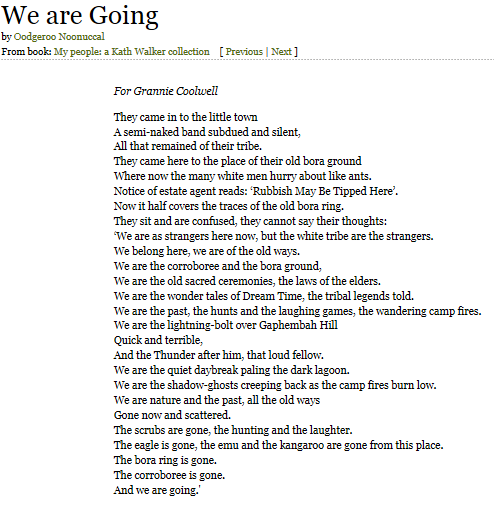
Students are to make notes on how this poem made them feel. What language choices evoked those emotions? Share with the person next to you. Then share with the class.
Write the key terms, language devices and emotions on the board so all students can connect the language choices and emotions.
This poem is full of extended metaphors. Ask students to highlight at least one example of an extended metaphor, and what it represents: what message is the author trying to convey to her readers? Discuss findings as a class.
Eg.
“We are the corroboree and the bora ground,
We are the old sacred ceremonies, the laws of the elders,
We are the wonder tales of Dream Time, the tribal legends told.
We are the past, the hunts and the laughing games, the wandering camp fires” (Noonuccal, 1970).
The people are not physically the corroboree and the bora ground; however, they represent all these sacred traditional places and symbols of their race that are being destroyed by the white people.
The poem conveys a message of loss and regret where the Aboriginal people’s old ways have been destroyed, the animals have left the sacred spaces and their connection to the land has been broken through the arrival of the white man, scurrying around like ants.
What meanings could the statement ‘rubbish may be tipped here’, have? Are they referring to the Aboriginal people as rubbish? Or the white men’s disregard and disrespect for the land and their complete lack of understanding of the symbolic and ceremonial importance of the site they are destroying? What effect does this language have on the reader?
Read the following article from news.com.au about What Life was Like for Aboriginal People During Colonisation:
Ask students to highlight passages of the article that echo with the poem.
Example:
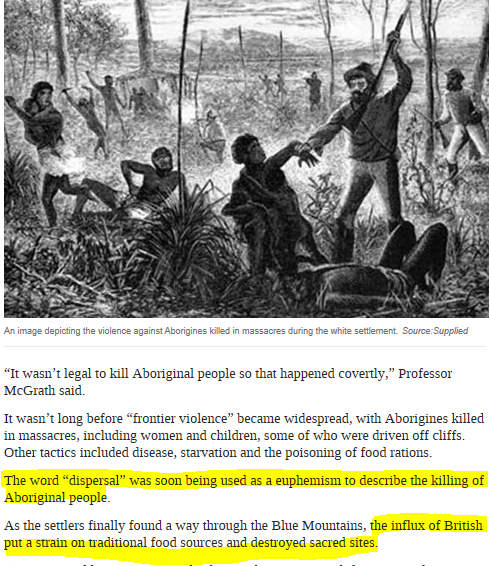
It is important that students understand that many poems are based on the lives of the authors or their ancestors. Many times, they are auto-biographical, and can be used to tell a story, promote change, or increase awareness around a political or social issue.
Apply Knowledge:
Students are now to create their own short poem using a variety of literary devices to evoke an emotional response in their reader. It does not need to rhyme but must contain at least 3 of the previously discussed elements: Metaphor, Extended Metaphor, Metonymy, Allegory, Icons, Myths and Symbolism.
When deciding how to structure your poem, you will need to think about your line length, arrangement, rhythm, line breaks and speed. These decisions will depend on the theme of your poem and what it is about.
To get started, jot down all your ideas, let your creativity flow.
Once you have a basic plan, put it into order and work on the structure and form.
Experiment with changes, try changing the line length or the order of ideas, and see what affect they have on the emotions created.
When creating your poem, consider the following questions:
What is the poem about?
What mood or feelings do I want my reader to have?
What speed do I want the poem to move? Should it speed up or slow down at any point?
What phrases or words do I want to stand out?
The more poems you read and write, the easier it becomes. These poems will be used in other activities, so ensure they are completed within a deadline. They may have one lesson to work on them during class time, and they must be completed for homework before the next activity begins.
Confirm Knowledge
Summarise the learning, and confirm students’ ability to listen to, view, read and create texts for different purposes and contexts. Ensure students are aware that their poem will be required for a future activity so it must be completed for homework if they are not yet finished
References
Australian Curriculum, Assessment and Reporting Authority, (2019). Australian Curriculum: English Syllabus F-10. Retrieved 6th August 2019 from https://www.australiancurriculum.edu.au/f-10-curriculum/english/
Chang, C. (2018) “What life was like for Aboriginal people during colonization”, news.com.au. Retrieved 14th August 2019 from https://www.news.com.au/national/politics/what-life-was-like-for-aboriginal-people-during-colonisation/news-story/0f3abec359c78d216d9315664eda132c
Noonuccal, O. (1970) “We are Going”, My people: a Kath Walker collection. Retrieved 13th August 2019 from https://www.poetrylibrary.edu.au/poets/noonuccal-oodgeroo/we-are-going-0771055
 Literacy as Language in Use