This activity is the first in the Literacy as Language in Use Key Ideas:
“An expanding vocabulary and grasp of grammatical and textual patterns sufficient to understand and learn from texts encountered in and out of school” (ACARA, 2019).
This idea can be connected through Year 9 English Content Descriptor:
ACELT1637:
” Investigate and experiment with the use and effect of extended metaphor, metonymy, allegory, icons, myths and symbolism in texts, for example poetry, short films, graphic novels, and plays on similar themes” (ACARA, 2019).
Students in Year 9 English are expected to obtain an expanding vocabulary and grasp of grammatical and textual patterns that are sufficient to understand and learn from texts encountered in and out of school. This is done through investigating and experimenting with the use and effect of extended metaphor, metonymy, allegory, icons, myths and symbolism in texts. This activity will explore the identification and understanding of these language devices within Australian Poetry.
Prior Knowledge:
Students have already learnt about Metaphor, Extended Metaphor, Metonymy, Allegory, Icons, Myths and Symbolism. However, before applying the use of literary devices within their poetry unit, it is advised to begin the lesson with a warm up activity to confirm and refresh the students’ prior knowledge of literary devices.
This can be done through the following game of Kahoot:
Open this link on your computer and project your screen onto the board in the classroom:
https://create.kahoot.it/share/1ffdbfdb-18f0-405c-8abe-dd32d52005b6
The opening page should appear like this:
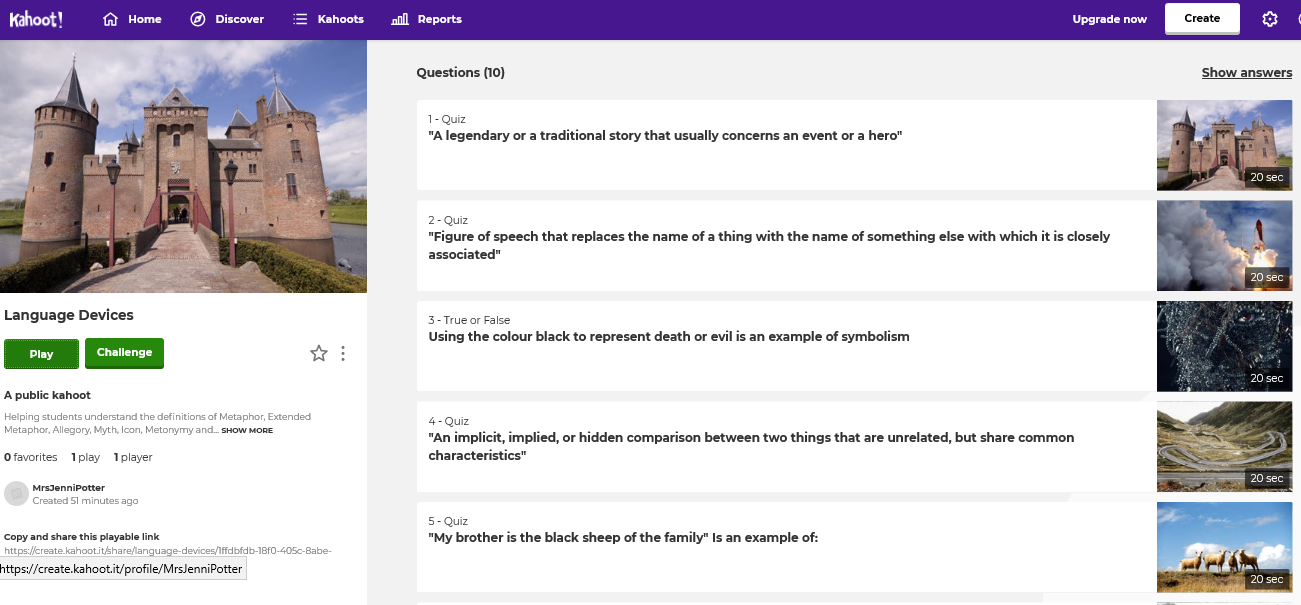
When you click “Play”, a separate screen will open which appears like this:

Click on “Player vs Player 1:1 Devices Classic”
Ask Students to open www.kahoot.it or the Kahoot! app on their devices and log in using the game ID provided on your screen.
It will appear like the below image: (Ensure you use the game pin provided on your live link, not the one in the image below).

Once all students have logged in, you can start the game. It is a fast-paced learning environment that allows students to be competitive while confirming their prior knowledge.
It is recommended that you read the questions and answer options aloud to ensure all students can take part in the activity and are not disadvantaged by an inability to read quickly.
Applying Knowledge:
Now that students have had their prior knowledge refreshed and confirmed, it is time to apply that learning through recognising these devices within the chosen literature.
Project the following poem onto the board and read it out loud to the students:
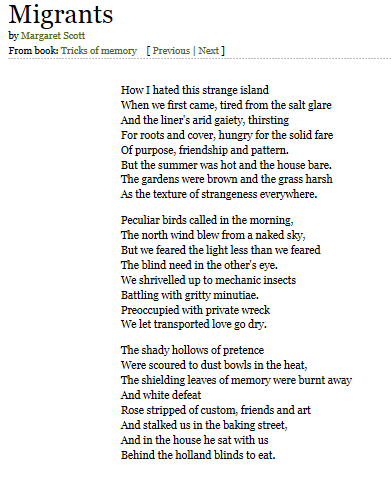
(Scott, 1980).
Ask the class to raise their hands to answer the following questions, and write their answers on the board:
What language does she use to describe the setting? What emotions does this convey?
Who is the main character? How does she feel about coming to Australia?
What language devices can you see?
Students are now instructed to work in groups of two to determine the meanings, settings, characters, themes, structures and language devices within one of the following poems:
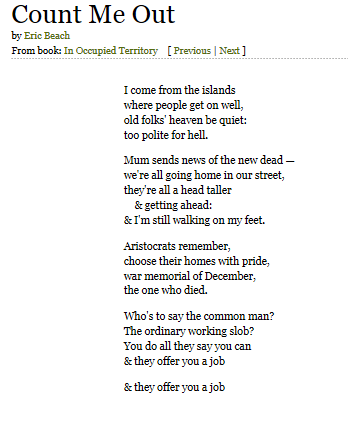
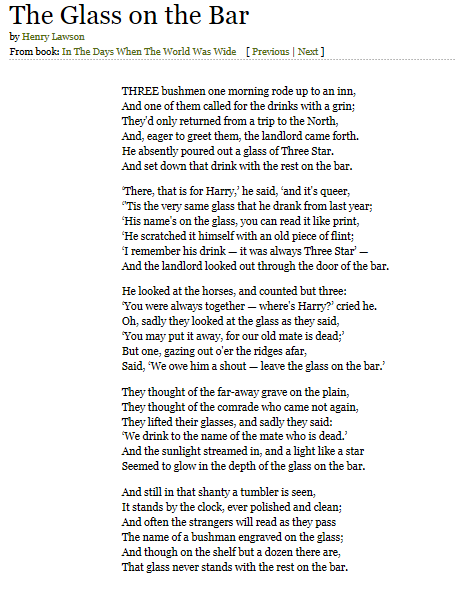
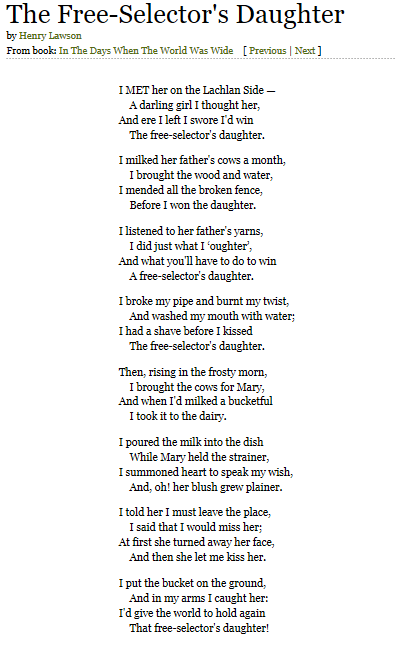
Each pair is to create a short oral presentation where they will read their chosen poem to the class and then discuss their findings regarding meanings, settings, characters, themes, structures and language devices.
Peers are to provide feedback and alternative findings. This allows students to become accustomed to receiving and applying peer feedback.
Confirm Knowledge:
It is important that students obtain an expanding vocabulary and grasp of grammatical and textual patterns sufficient to understand and learn from texts encountered in and out of school. By investigating and experimenting with the use and effect of extended metaphor, metonymy, allegory, icons, myths and symbolism in texts, for example poetry, short films, graphic novels, and plays on similar themes, students expand their vocabulary and extend their understanding of a range of texts.
References
Australian Curriculum, Assessment and Reporting Authority, (2019). Australian Curriculum: English Syllabus F-10. Retrieved 6th August 2019 from https://www.australiancurriculum.edu.au/f-10-curriculum/english/
Beach, E. (1977) “Count Me Out”, In Occupied Territory, Retrieved 13th August 2019 from https://www.poetrylibrary.edu.au/poets/beach-eric/count-me-out-0175005
Lawson, H. (1900) “The Glass on the Bar”, In the Days When the World Was Wide, Retrieved 13th August 2019 from https://www.poetrylibrary.edu.au/poets/lawson-henry/the-glass-on-the-bar-0002015
Lawson, H. (1900) “The Free-Selector’s Daughter”, In the Days When the World was Wide, Retrieved 13th August 2019 from https://www.poetrylibrary.edu.au/poets/lawson-henry/the-free-selector-s-daughter-0002008
Scott, M. (1980). “Migrants”, Tricks of Memory. Retrieved 13th August 2019 from https://www.poetrylibrary.edu.au/poets/scott-margaret/migrants-0745008

